



Specifications
|
Item |
Specification |
|
Product Type |
Bamboo Fiber Three-Wave Wall Panel |
|
Source-Listed Series |
200 Series - Not Confirmed as 200 mm |
|
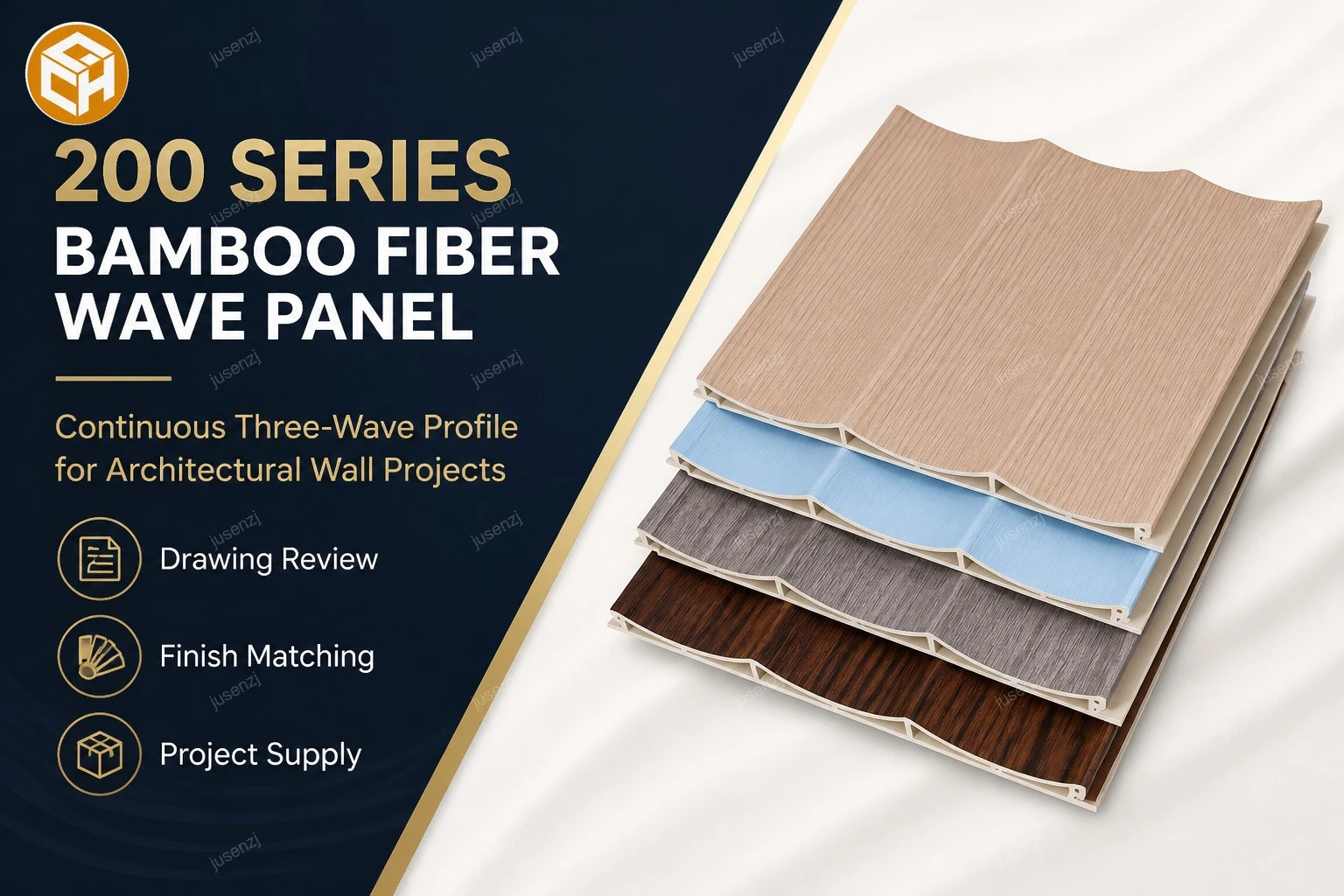
Visible Profile |
Continuous Thin Panel / Three Broad Crests / Smooth Valleys / Slim Edge |
|
Visible Finishes |
Pink Wood / Light Blue / Gray Wood / Dark Wood |
|
Material Formulation |
On Request |
|
Bamboo Fiber Content |
On Request |
|
Panel Width |
On Request |
|
Panel Thickness |
On Request |
|
Panel Length |
On Request |
|
Installation System |
On Request |
|
Performance Data |
On Request |
|
Application |
Hotel Reception / Retail Showroom / Interior Accent Wall |
|
Custom Size |
Available after drawing and order review |
|
Private Label |
Available |
|
Sample Approval |
Available |
|
Mixed Container |
Available after order review |
|
Packing |
On Request |
|
MOQ |
500 Square Meter / Each Color or Finish |
|
Production Schedule |
On Request |
|
Certification |
CE · RoHS |
Product Introduction
A multi-finish architectural wall-panel family with a thin continuous sheet, three broad rounded wave zones, smooth valleys, a slim edge profile, and source-visible pink, blue, gray, and dark wood finishes.
Detailed Description
The 200 series bamboo fiber wave wall panel collection is prepared for distributors, interior-fit-out companies, commercial project buyers, and wholesale customers seeking a broad linear architectural surface. The supplied reference identifies the product in Chinese as a 200 series bamboo-fiber panel and shows four visible finishes: pink or light wood, light blue, gray wood, and dark brown. Visible product identity is defined by a thin continuous panel, three broad rounded wave zones, gently recessed valleys, a slim edge profile, and small internal support channels visible at the cut end. The source is used as the sole identity anchor; its advertising statements are not treated as independently verified technical evidence.
The number 200 is retained only as a source-listed series designation. It is not confirmed as a 200 mm panel width or any other dimension. Exact material formulation, bamboo-fiber content, panel width, thickness, length, wave spacing, edge detail, surface process, installation method, accessories, packing configuration, and production schedule remain On Request. Source advertising refers to corrosion resistance, moisture resistance, resistance to deformation or cracking, and a clear texture. These statements require technical confirmation and must not be used as verified specifications, warranties, or project-performance claims without supporting documentation.
For project review, the visible profile should be checked against an approved physical sample and the final drawing. Sample review should confirm the three-wave rhythm, crest contour, valley transition, slim edge appearance, cut-end channel pattern, grain direction, gloss, color response under project lighting, and consistency between approved samples and production batches. Installation hardware and joint details are not visible in the reference and must be confirmed before order. The product should not be interpreted as narrow fluted slats, separate square tubes, decking boards, corrugated metal roofing, or a solid beam merely because its wave surface creates a linear effect.
Factory coordination can cover drawing review, cut-to-size review, finish matching, profile-sample approval, batch comparison, private-label packing, carton marking, pallet planning, and mixed-container support. The minimum order quantity is 500 Square Meter for each color or finish. CE and RoHS documentation may be supplied where applicable. Any other material report, performance report, test method, project submittal, or compliance document is available only when supported and requested. No additional certification, rating, warranty, or performance claim is implied.
Before production, the buyer should confirm final profile geometry, all dimensions, finish reference, quantities, installation direction, joint layout, support spacing, edge treatment, corner treatment, substrate conditions, accessories, labels, protective method, carton configuration, pallet plan, destination requirements, and inspection criteria. Retained samples and batch comparison are recommended for phased projects. The 200 series bamboo fiber wave wall panel range is positioned as a source-grounded three-wave architectural wall-panel family for bulk purchasing, drawing-based review, finish approval, sample confirmation, private-label coordination, and repeatable project supply.
Ordering Information
- Confirm profile geometry, dimensions, wave spacing, supports, joints, edges, and accessories against project drawings.
- Approve physical profile and finish samples before production.
- MOQ: 500 Square Meter / Each Color or Finish.
- Packing, production schedule, and performance data: On Request.
- Documentation: CE and RoHS; supported test reports on request.


FAQ
Q1. How is it better than real timber?
A: Real timber needs oiling or staining every year, and even then it moves, splits and greys within two or three summers. WPC takes no water, so it cannot rot or feed termites, and the ASA cap holds colour without a coating. Upfront, hardwood costs less per square metre; over ten years the maintenance you avoid usually closes the gap. Where the wall is wet, coastal, shaded or pool-side, timber rarely survives long enough to argue about price.
Q2. Will the colour fade over time?
A: The cap is co-extruded ASA, which is UV-stabilised, so chalking and greying are slow rather than absent. Light greys, creams and woodtones hold best; saturated black, dark walnut and reds shift most because they absorb more solar energy. A south or west facade in a hot climate will show change sooner than a shaded one. Where the design allows, choose a mid or light tone and the difference after years is small.
Q3. How much movement must I allow?
A: WPC moves with temperature, roughly 5 mm at each end on a 2.9 m slat between a cold night and a hot afternoon, so leave that gap and let the clip carry it. Never butt slats hard against a wall, a corner or a starter track. If you fix rigidly through the face, the run has nowhere to go and will bow off the battens in the first heat wave; that is an installation error, not a material fault.
Q4. Can it be fixed straight onto the wall?
A: No. Fix treated battens or an aluminium sub-frame first, then clip the slats so a ventilated cavity of at least 20 mm sits behind them. The cavity lets water drain, lets the wall dry and keeps the profile off a damp surface. Fixed directly, trapped moisture shows up as efflorescence on masonry, blistering on render, and a green film in the shadow of the slat.
Q5. What fire rating does it carry?
A: The standard profile is not rated. On the flame-retardant grade the material reaches B1 to GB 8624, and CE and RoHS documents are supplied with the order. Where the project needs a European classification, tell us the class written in the specification and we confirm what we can support before you price it, rather than after the sample has been approved.
Q6. Is there formaldehyde or VOC?
A: No formaldehyde. The binder is HDPE, a polyolefin, not a urea, melamine or phenolic resin, and the wood flour is encapsulated in the polymer matrix instead of being glued. There is nothing in the profile to off-gas, which is why it is used inside bathrooms, clinics and shopfitting. RoHS documentation is available for buyers who need it on file.
Q7. How is it cleaned, and does it grow mould?
A: Wash with water and a soft brush once or twice a year, and use a mild household detergent where a film has built up. Algae and mildew grow on dirt and pollen sitting on the surface, not inside the material, so a wash removes them and they do not return from within. Avoid solvent cleaners and abrasive pads, which dull the cap, and keep a high-pressure jet away from the profile.
Q8. Can I use it indoors as well?
A: Yes, and this is often why buyers consolidate on one supplier. The same profile runs on bathroom and shower walls, reception features, ceilings, shopfitting and balcony soffits, and thinner indoor sections exist where depth is tight. One colour family then covers inside and outside, so a terrace and the room behind it read as a single scheme.
Q9. Can it be cut, curved or drilled on site?
A: Cut and drill with ordinary woodworking tools and a fine-tooth blade; a mitre saw gives a clean end, and a touch-up pen hides the cut. Gentle bends can be taken over a large radius, but tight curves and returns need a formed corner or a matching trim rather than force. Keep the cut end clear of the ground and seal it where the profile faces driven rain.
Q10. What is the MOQ, lead time and paperwork?
A: 500 square metres per order, with 7 to 30 days production depending on colour and profile, because a non-stock colour needs its own extrusion run. CE and RoHS documents ship with the order, and a cut sample of the actual cap goes out before you commit, so the colour is approved on the real surface. Give us the wall area and profile and we return a quantity with wastage included.
Hot Tags: 200 series bamboo fiber three-wave wall panel, China 200 series bamboo fiber three-wave wall panel manufacturers, suppliers, factory, WPC Fence Panel, wpc panel, WPC panel 3D wood grain emboss, WPC panel width 150mm, WPC wall panel 60 wood fiber, WPC Wood Cladding


